OPEC+ Explained: Required Production, Voluntary Adjustments, and Limits
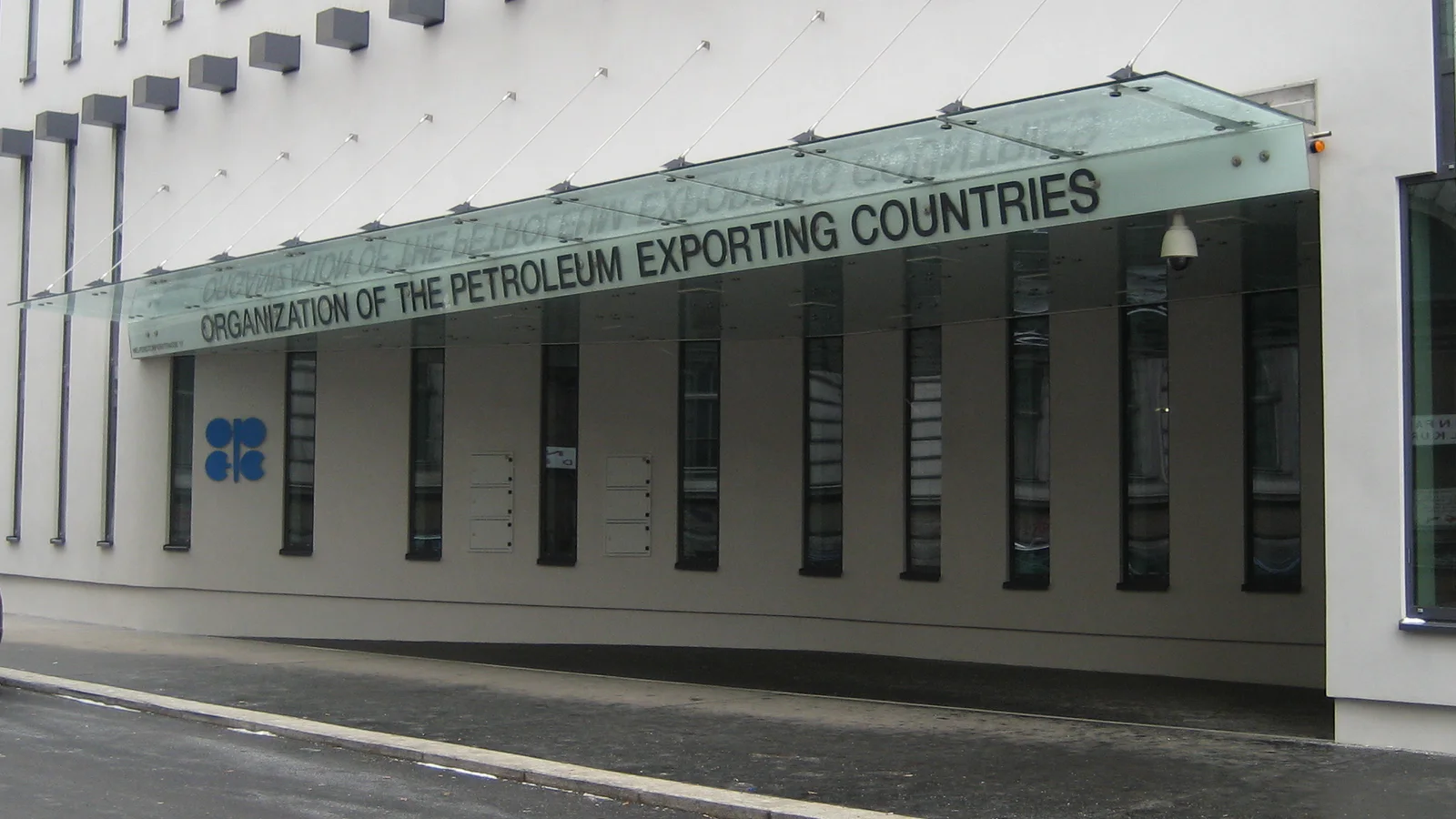
Image: Priwo / Wikimedia Commons
OPEC+ is shorthand for OPEC members and non-OPEC countries participating in the Declaration of Cooperation. The group coordinates production policy, but it does not set a legal global oil price and its announced production levels are not the same as measured output.
Source check: 27 July 2026. Production policy can change at scheduled or extraordinary meetings.
OPEC, OPEC+, and voluntary groups
These labels can refer to different country sets:
- OPEC is the intergovernmental organization and its member countries.
- Declaration of Cooperation participants include OPEC and participating non-OPEC producers.
- Voluntary-adjustment countries are a smaller subset that may announce additional changes.
Always use the country list in the specific statement. Do not apply a seven-country voluntary decision to every OPEC+ participant.
Required level versus actual production
An official statement may describe a required production level or an adjustment from an earlier voluntary cut. To estimate the physical effect, compare:
- the prior required level;
- the new required level;
- reported actual production before the decision;
- capacity and operational constraints;
- compensation for earlier overproduction;
- exempt or differently treated participants.
If a country was already producing below its required level, a higher requirement may not create the full headline increase. If it previously overproduced, a compensation plan may offset later output.
The current dated example
On 5 July 2026, seven countries—Saudi Arabia, Russia, Iraq, Kuwait, Kazakhstan, Algeria, and Oman—announced a 188,000-barrel-per-day adjustment for August 2026. The statement said the underlying voluntary adjustments could be returned in part or full, gradually, and that the phase-out could be increased, paused, or reversed as conditions evolved.
OPEC also said the countries intended to compensate for overproduced volumes and would meet again on 2 August. Those conditions are part of the announcement; omitting them makes the number look more certain than it is.
Separately, the 41st OPEC and non-OPEC Ministerial Meeting on 7 June reaffirmed overall production levels through 31 December 2026 and the monitoring and compensation framework.
What the group can influence
Coordinated restraint can reduce supply relative to what participants might otherwise produce. Returning withheld volumes can add supply. The expected price effect depends on demand, inventories, non-participant production, disruptions, refinery needs, crude quality, freight, and market expectations.
The group can surprise a forecast even before barrels change because futures and physical differentials incorporate expectations. That market response is not proof of the eventual production outcome.
Spare capacity requires a definition
Spare capacity is often described as production that can be brought online within a specified time and sustained for a specified period. Estimates differ because analysts use different time windows, maintenance assumptions, crude grades, and political judgments.
Name the estimating organization and definition. Do not equate a required level below a theoretical maximum with immediately usable spare capacity.
A meeting-day checklist
- Link the primary OPEC statement.
- Record the exact participating countries.
- Capture implementation month and unit.
- Compare new and prior required levels.
- Note pause, reversal, and compensation language.
- Compare required levels with later production estimates.
- Separate the group’s stated market assessment from independent data.
OPEC+ is influential, but a production plan is one input in a global balance, not a guarantee of price direction.
Primary sources
- OPEC: 5 July 2026 voluntary-adjustment statement
- OPEC: 41st OPEC and non-OPEC Ministerial Meeting
- OPEC: Declaration of Cooperation
- EIA: Short-Term Energy Outlook
opecopec plusoil supplyproduction adjustmentsquotasenergy educationexplainer